
Fire Risk Assessments.
Structured. Compliant. Defensible.
Professional fire risk assessments aligned with the Fire Safety Order 2005 and the Fire Safety (England) Regulations 2022 — delivered with clarity, documentation, and actionable guidance.
What Is a Fire Risk Assessment —
And Why Is It Legally Required?
A Fire Risk Assessment (FRA) is a structured evaluation of fire hazards within a building, identifying risks to occupants and determining appropriate control measures.
Under the Regulatory Reform (Fire Safety) Order 2005, the responsible person must:
- Identify fire hazards
- Evaluate risk to occupants
- Remove or reduce risk where possible
- Record significant findings
- Review the assessment regularly
Failure to conduct or update an FRA may result in enforcement notices, fines, or prosecution.

Who Is Legally Responsible?

You are likely required to conduct a fire risk assessment if you are:
- A landlord of an HMO or residential block
- A commercial property owner
- A business operator
- A care home provider
- A facilities or property manager
- A facilities or property manager Responsible for common areas in multi-occupancy buildings
If your building contains shared escape routes, communal areas, or staff, an FRA is not optional — it is a legal obligation.
What Does an OFHSES
Fire Risk Assessment Cover?
Our structured process examines:
Fire Hazards
- Electrical risks
- Combustible materials
- Storage and housekeeping
- Ignition sources
Escape Routes
- Corridor width and access
- Stairwell condition
- Signage and emergency lighting
- Obstruction checks
Fire Detection & Warning
- Alarm coverage
- Maintenance records
- Testing frequency
Fire Doors & Compartmentation
- Door integrity
- Seals and closers
- Gaps and fitting
- Structural separation
Firefighting Equipment
- Extinguishers
- Maintenance status
- Correct placement
How OFHSES Conducts Fire Risk Assessments
We operate a disciplined four-stage model:
Step 1 — Pre-Assessment Information Review
We gather key building details and occupancy profile.
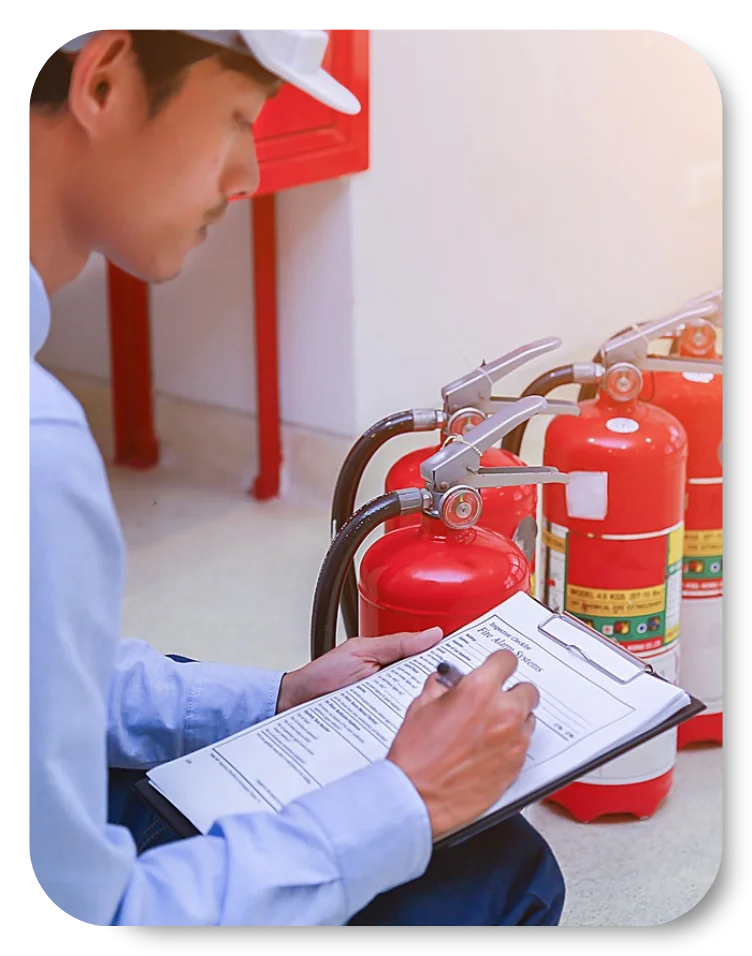
Step 2 — On-Site Inspection
A systematic inspection aligned with regulatory standards.
Step 3 — Risk Evaluation & Categorisation
Risks are clearly classified (Low / Medium / High).
Each risk includes:
- Clear description
- Impact explanation
- Recommended corrective action
- Priority level
Step 4 — Actionable Compliance Roadmap
We provide a structured action plan prioritised by urgency. No vague language. No ambiguous recommendations.
How Often Should a Fire Risk Assessment Process Be Updated?
An FRA should be reviewed:
- Annually (recommended best practice)
- When building layout changes
- After occupancy increases
- Following significant renovation
- After fire incidents
- When regulations are updated
Failure to review assessments is one of the most common compliance failures.
Frequent Issues Found in UK Properties.
Through field experience, we commonly identify:
Non-compliant fire door gaps
Missing self-closers
Blocked escape routes
Inadequate signage
Outdated fire alarm testing logs
Compartmentation breaches
Early identification reduces enforcement risk and protects occupants.

Your Fire Risk Assessment Report Includes:
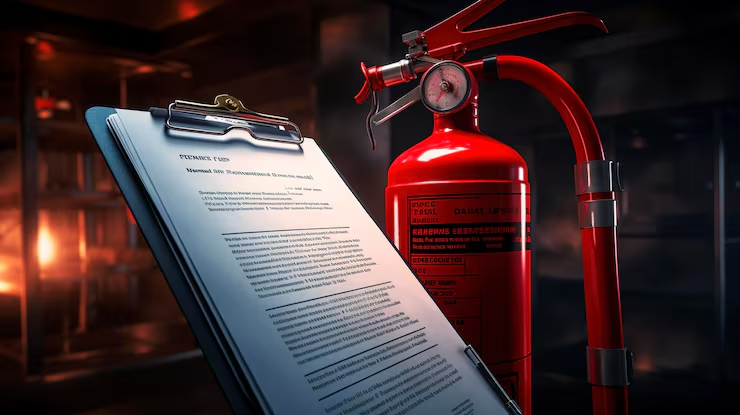
- Executive summary
- Detailed findings
- Photographic evidence (where applicable)
- Risk categorisation
- Prioritised action plan
- Compliance guidance notes
Reports are written in clear, structured language suitable for landlords, management teams, and enforcement bodies.
Clarity Over Confusion. Structure Over Guesswork.
OFHSES stands apart through:
- Certified expertise
- Structured documentation
- Transparent reporting
- Clear action guidance
- Alignment with current UK regulations
- Accountability and traceability
We do not deliver generic checklists.
We deliver defensible assessments.

How Much Does a Fire Risk Assessment Cost?
Costs depend on:
- Property type
- Number of floors
- Size and complexity
- Occupancy profile
Indicative starting point:
From £245 + VAT (where applicable) for small premises.
Use our estimator tool for a structured range.
Is a Fire Risk Assessment a legal requirement?
Yes, for most non-domestic premises and shared residential buildings under UK law.
Can I conduct my own fire risk assessment?
In small, simple premises, this may be possible. However, complex or multi-occupancy buildings require professional expertise.
What happens if I do not have an FRA?
Enforcement notices, fines, and potential prosecution.
How long does an FRA take?
Varies depending on property size and complexity.

Secure Your Compliance With Confidence.
Avoid enforcement risk.
Protect occupants.
Gain structured clarity.