The Fire Safety (England) Regulations 2022 introduced additional legal duties for those responsible for fire safety in multi-occupied residential buildings. These duties include providing residents with fire safety information, checking certain fire doors and, in qualifying high-rise buildings, making specific information available to fire and rescue services.
For landlords, property owners and building managers, understanding the regulations is important because the requirements differ according to the building’s characteristics and the responsibilities of the people managing it.
For example, qualifying residential buildings above 11 metres must have communal fire doors checked at least every three months. The Responsible Person must also use best endeavours to check flat entrance doors at least every 12 months. Additional requirements apply to high-rise residential buildings that are at least 18 metres high or have at least seven storeys.
The regulations came into force on 23 January 2023 and apply in England. They supplement existing fire safety legislation rather than replace it.
This guide explains what the regulations require, which buildings are covered, how fire door checks should be managed, what information residents must receive and how landlords can organise their compliance responsibilities.
What Are the Fire Safety (England) Regulations 2022?
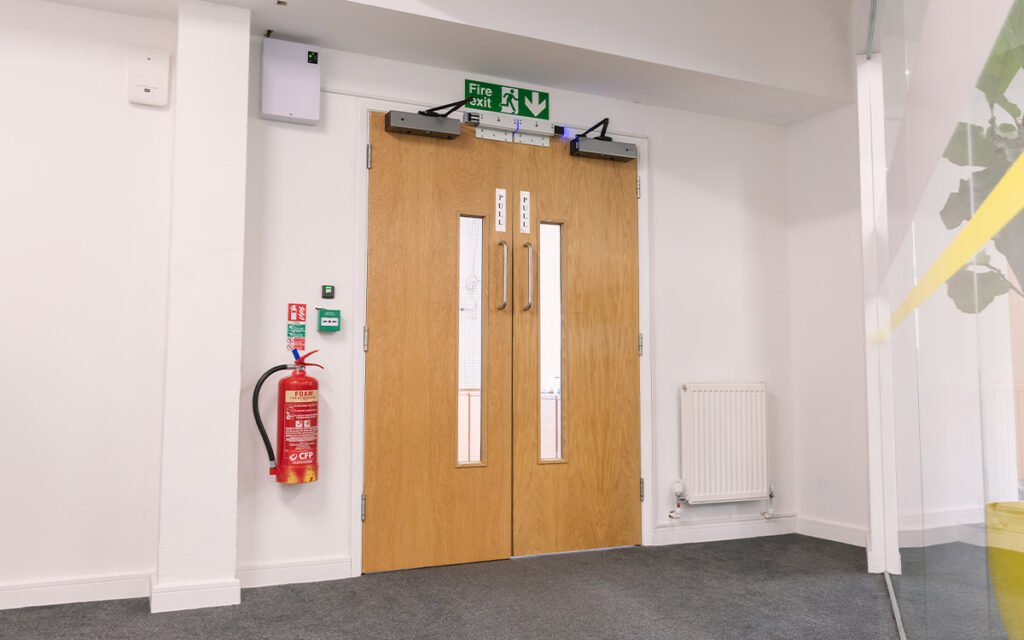
The Fire Safety (England) Regulations 2022 are secondary legislation made under the Regulatory Reform (Fire Safety) Order 2005. They introduced additional fire safety duties following recommendations from the Grenfell Tower Inquiry’s Phase 1 report.
Their purpose is to strengthen fire safety arrangements in multi-occupied residential buildings by improving resident information, supporting fire and rescue service planning and establishing specific requirements for fire doors and certain building safety information.
The regulations cover several areas, including:
- Fire safety instructions for residents.
- Information about the importance and use of fire doors.
- Quarterly checks of communal fire doors in qualifying buildings.
- Best-endeavours annual checks of flat entrance doors in qualifying buildings.
- Secure information boxes in high-rise residential buildings.
- Records of external wall design and materials.
- Building floor plans and other information for fire and rescue services.
- Checks of specified lifts and essential firefighting equipment.
- Wayfinding signage in high-rise residential buildings.
Not every requirement applies to every residential property. Some duties apply broadly to qualifying multi-occupied residential buildings, while others are restricted to buildings above specified height thresholds.
The legislation can be read in full here: The Fire Safety (England) Regulations 2022.
Do the regulations apply throughout the UK?
No. The Fire Safety (England) Regulations 2022 apply in England only.
Although some wider fire safety legislation applies in England and Wales, the devolved nations have their own legal and regulatory arrangements. Landlords and building managers in Scotland, Wales or Northern Ireland should consult the relevant legislation and official guidance for their location.
This distinction matters when managing properties in different parts of the UK. A landlord should not assume that a requirement under the England-specific regulations automatically applies elsewhere in the same way.
Which Residential Buildings Are Covered?
The regulations distinguish between multi-occupied residential buildings and high-rise residential buildings. Understanding the difference is essential when determining which duties apply.
Multi-occupied residential buildings
Several provisions apply to buildings containing two or more sets of domestic premises. For certain duties, the building must also contain common parts through which residents would need to evacuate in an emergency.
Common parts may include shared corridors, staircases, entrance halls and other communal areas.
A building containing separate flats and shared internal escape routes may fall within this framework. However, a landlord should not assume that every property described as an HMO automatically falls within every provision of the regulations.
The legal classification depends on the actual building, its domestic premises, common parts and the wording of the relevant regulation.
Buildings above 11 metres
For the fire door checking requirements in Regulation 10, the building must contain two or more sets of domestic premises and be above 11 metres in height.
In these qualifying buildings, the Responsible Person must undertake checks of fire doors in communal areas at least every three months.
The Responsible Person must also use best endeavours to undertake checks of fire doors at the entrances to individual domestic premises at least every 12 months.
The precise statutory wording matters: these requirements should not be presented as applying to every building at or below the threshold.
High-rise residential buildings
The regulations define a high-rise residential building as a building containing two or more sets of domestic premises that:
- Is at least 18 metres above ground level; or
- Has at least seven storeys.
Both criteria are not required simultaneously.
The height and storey count must be determined using the rules set out in the legislation. Below-ground storeys are excluded from the storey count, and certain mezzanine floors count as storeys where they meet the statutory floor-area test.
Qualifying high-rise residential buildings have additional requirements relating to building information, fire and rescue service access, lifts and wayfinding signage.
Understanding the building thresholds
| Building category | Important requirements |
| Qualifying multi-occupied residential building with common parts | Fire safety instructions for residents and relevant information about fire doors. |
| Qualifying building above 11 metres | Quarterly checks of communal fire doors and best-endeavours annual checks of flat entrance doors. |
| High-rise residential building: at least 18 metres or at least seven storeys | Additional requirements, including a secure information box, external wall information, building plans, specified equipment checks and wayfinding signage. |
This table is a summary rather than a complete legal determination. Each provision should be checked against the relevant statutory definition and building circumstances.
Official guidance is available in the government’s overview of the Fire Safety (England) Regulations 2022.
What Must the Responsible Person Do?
The regulations place duties on the Responsible Person under the wider fire safety framework.
The Responsible Person is a legal concept defined by the Regulatory Reform (Fire Safety) Order 2005. Depending on the circumstances, it may be the employer, a person who has control of the premises or the person who owns the premises where the relevant provisions apply.
In residential buildings, the person responsible for the freehold, a managing agent or another party with relevant control may have responsibilities. The precise position depends on the facts, the nature of the premises and the applicable legal provisions.
A management contract or appointment of a contractor does not automatically transfer or eliminate the Responsible Person’s legal duties.
Practical responsibilities
Depending on the building and the provisions that apply, the Responsible Person may need to:
- Identify which statutory duties apply to the building.
- Ensure required fire safety instructions are provided to residents.
- Establish a suitable schedule for fire door checks.
- Record the steps taken to meet the best-endeavours annual flat entrance door checking duty.
- Address defects identified during checks.
- Maintain required building information and records.
- Provide specified information to the fire and rescue service.
- Ensure relevant equipment and signage requirements are met in qualifying high-rise buildings.
- Continue meeting wider duties under the Fire Safety Order.
Where more than one party has fire safety responsibilities, the parties should clarify their respective roles and coordinate their work. They should not assume that appointing a managing agent or inspection company makes the underlying statutory responsibilities disappear.
The government’s guide to checking fire safety responsibilities provides a useful starting point.
Fire Door Checks in Buildings Above 11 Metres
Regulation 10 establishes specific checking requirements for qualifying multi-occupied residential buildings above 11 metres.
The purpose of these checks is to help ensure that relevant fire doors remain functional and that faults can be identified and addressed.
How often must fire doors be checked?
The two main checking duties are different.
| Door type | Applicable building | Statutory checking requirement | Important limitation |
| Fire doors in communal areas | Qualifying multi-occupied residential building above 11 metres | At least every three months | Checks must include ensuring that self-closing devices work. |
| Fire doors at the entrances to individual domestic premises | Qualifying multi-occupied residential building above 11 metres | Best endeavours to check at least every 12 months | The Responsible Person must record steps taken, including attempts to gain access where access is not granted. |
These are statutory checking duties under Regulation 10. The annual flat entrance door requirement is expressly framed as a best-endeavours obligation; it should not be described as an unconditional guarantee that every resident will provide access.
The regulations also require information about fire doors to be provided to residents of qualifying buildings containing two or more sets of domestic premises and common parts through which residents would need to evacuate in an emergency.
The relevant provisions can be read in Regulation 10 of the Fire Safety (England) Regulations 2022.
What should a communal fire door check include?
The statutory requirement expressly includes checking that self-closing devices are working.
In practice, routine checks may also help identify visible damage, faults or other signs that a door needs attention. The government has published specific guidance to help Responsible Persons carry out simple checks.
Depending on the door and its intended function, useful observations may include:
- Whether the door closes properly from an appropriate open position.
- Whether the self-closing device appears damaged or ineffective.
- Whether the door leaf or frame has visible damage.
- Whether hinges, latches or other components appear loose or defective.
- Whether the door is obstructed or being held open in a way that compromises its function.
- Whether visible seals or other components appear damaged or missing where they form part of the relevant door assembly.
These observations are practical examples, not a claim that Regulation 10 prescribes an identical technical inspection checklist for every door.
The relevant fire risk assessment, door specification, applicable guidance and the nature of any defect determine what further examination or remedial work may be needed.
Do the regulations require every existing flat entrance door to be replaced?
No. The purpose of the regulations is not to require all existing flat entrance doors to be replaced simply because they were not manufactured or certificated to the standards for new fire doors.
The government’s revised fire door guidance, updated on 8 August 2025, specifically addresses misunderstandings that have led to unnecessary pressure on leaseholders to replace existing doors.
The key objective is to ensure that doors perform their intended fire safety function, including the effective operation of self-closing devices where applicable. A defect should be assessed in context, and any proposed repair or replacement should be based on the door’s condition, intended performance and relevant requirements.
See the official Fire Safety (England) Regulations 2022 fire door guidance.
What happens when access to a flat is refused?
For qualifying buildings above 11 metres, the Responsible Person must use best endeavours to undertake the annual checks of flat entrance doors.
The regulations also require a record of the steps taken to comply with this obligation, including steps taken to try to gain access where entry was not granted during a 12-month period.
A practical procedure may include giving advance notice, contacting the resident, arranging an alternative appointment and keeping a record of attempted visits and communications.
These are examples of practical steps, not an exhaustive statutory list. The Responsible Person should keep a clear record of the actual efforts made and determine what further steps are reasonable in the circumstances.
An unsuccessful attempt should not simply be recorded as a completed inspection. The record should distinguish between a door that was checked and one that could not be accessed.
Additional Fire Safety Duties for Taller Residential Buildings
The regulations impose additional duties on high-rise residential buildings meeting the statutory definition of at least 18 metres in height or at least seven storeys.
These provisions are intended to help fire and rescue services understand the building, locate important information and respond effectively to emergencies.
Secure information box
A qualifying high-rise residential building must have a suitable secure information box containing specified information.
The contents include relevant UK contact details and building plans. The Responsible Person must also ensure the box remains suitable and inspect it at least annually in accordance with the regulations.
The box should be accessible to the appropriate people while remaining secure.
External wall information
The Responsible Person must prepare and maintain a record of the building’s external wall design and materials.
The record must include the level of risk identified in the relevant fire risk assessment arising from the design and materials of the external walls, together with mitigating steps taken in respect of that risk.
A revised record is required where there are significant changes to the external walls.
This duty should not be confused with a universal requirement for every residential landlord to commission the same external wall assessment. It applies within the scope of the relevant high-rise building provisions.
Floor plans and building plans
For qualifying high-rise residential buildings, the Responsible Person must prepare plans for each floor, subject to the applicable requirements.
The plans must identify specified firefighting equipment and other relevant information. Required electronic information must be provided to the local fire and rescue authority, and hard copies must be held in the secure information box as prescribed.
Plans should be kept up to date when relevant changes occur.
Lifts and essential firefighting equipment
The regulations require at least monthly checks of the operation of lifts intended for use by firefighters and specified essential firefighting equipment in qualifying high-rise residential buildings.
The Responsible Person must inform the local fire and rescue authority if a relevant lift or specified piece of equipment is out of order for longer than 24 hours.
The scope of these requirements should be checked against the relevant statutory provisions; they should not be presented as applying to every lift in every residential building.
Wayfinding signage
Qualifying high-rise residential buildings must have wayfinding signage that meets the requirements of the regulations, including visibility in low-light conditions.
The signage is intended to assist firefighters in identifying floors and navigating the building during an incident.
Building managers should verify that the signage is suitable for the building and remains in the required condition.
For the full set of provisions, consult the Fire Safety (England) Regulations 2022 and the government’s Responsible Person guidance.
What Fire Safety Information Must Residents Receive?
The regulations contain two related but distinct sets of resident information duties.
Fire safety instructions under Regulation 9
For qualifying multi-occupied residential buildings containing two or more sets of domestic premises and common parts, the Responsible Person must provide residents with fire safety instructions.
The instructions must cover:
- How to report a fire.
- A reminder of the building’s evacuation strategy.
- What residents should do when a fire occurs, in accordance with that strategy.
The information should be provided in a form that residents can reasonably be expected to understand.
The government advises Responsible Persons to display the instructions clearly in communal or conspicuous areas and provide them directly to residents when they move into the building. The information must also be provided annually and updated when the relevant document changes.
The specific legal obligation is to provide the required instructions. Displaying them clearly and taking practical steps to help residents understand them are important elements of implementing that duty.
Fire door information under Regulation 10
Residents in qualifying buildings must also receive information about the importance of fire doors.
This information must explain that:
- Fire doors should be kept shut when not in use.
- Residents and their guests should not tamper with self-closing devices.
- Faults or damage to fire doors should be reported immediately to the Responsible Person.
The information must be provided to a new resident as soon as reasonably practicable after they move in and to all residents within each 12-month period specified by the regulations.
These requirements are separate from the general fire safety instructions under Regulation 9. Building managers should ensure that both sets of information are addressed where both provisions apply.
Official sources include the government’s Regulation 9 resident information fact sheet and Regulation 10 fire door guidance.
What Records Should Building Managers Keep?
Record-keeping supports the management of fire safety responsibilities, helps identify outstanding defects and provides evidence of actions taken.
The exact records required depend on the provision and the building.
For example, Regulation 10 specifically requires the Responsible Person to keep a record of the steps taken to meet the best-endeavours annual flat entrance door checking duty, including efforts to gain access where entry is not granted.
Other provisions require particular building information, plans or records to be prepared and maintained.
A practical record-management system may include:
- Records of flat entrance door access attempts and checks.
- Communal fire door checking records.
- Defects identified and actions taken.
- Relevant fire risk assessment findings and reviews.
- Resident fire safety instructions and evidence of distribution.
- Relevant external wall information and updates, where required.
- Building plans and secure information box checks, where applicable.
- Monthly lift and essential firefighting equipment checks, where applicable.
- Records of relevant notifications to the fire and rescue authority.
Not every item in this list is subject to the same explicit record-keeping requirement under the 2022 Regulations. Some are records required by specific provisions; others are useful evidence of the wider management process.
Records should be accurate, accessible to those who need them and updated when inspections, defects, repairs or material changes occur.
How Do the 2022 Regulations Relate to a Fire Risk Assessment?
The Fire Safety (England) Regulations 2022 supplement the existing fire safety framework. They do not replace the need to comply with the Regulatory Reform (Fire Safety) Order 2005 where it applies.
The Fire Safety Order requires the Responsible Person to ensure that a suitable and sufficient fire risk assessment is undertaken for premises within its scope.
The assessment helps identify hazards, evaluate existing precautions and determine what additional measures are needed.
For residential buildings, this wider assessment process remains important even where the specific checking requirements of Regulation 10 do not apply because a building is not above 11 metres.
A building manager should not interpret the absence of a particular quarterly or annual statutory checking duty as permission to ignore defective fire doors or other fire safety risks.
The assessment, applicable legal duties, building configuration and relevant guidance should inform the appropriate inspection and maintenance arrangements.
Where an assessment identifies problems with fire doors, compartmentation, escape routes or other fire safety measures, the Responsible Person should ensure appropriate action is taken.
For more information, read the OFHSES guide to how often a fire risk assessment should be reviewed in the UK.
What Happens If a Building Does Not Comply?
The consequences of non-compliance depend on the relevant legal provision, the seriousness of the breach and the circumstances of the case.
Fire safety enforcement is not limited to one automatic penalty. The enforcing authority may consider advice, requests for corrective action, non-statutory notices or formal statutory notices, depending on the situation and its powers.
For most premises, the local fire and rescue authority is the enforcing authority, although other bodies have responsibility for certain types of premises.
Under the Fire Safety Order and regulations made under it, an enforcing authority may take formal action where the legal conditions are met. Serious breaches, risks of death or serious injury, or failures to comply with statutory notices may lead to prosecution and criminal sanctions.
The current government guidance explains the enforcement framework and available sanctions: Fire Safety Order: enforcement and sanctions for non-compliance.
Progressive evacuation is not a penalty for non-compliance. It is an evacuation approach that may be relevant to a building’s fire safety strategy and must be considered in the appropriate context.
Landlords and building managers who receive an enforcement notice should read its requirements carefully, identify the relevant deadlines and seek appropriate professional or legal advice where necessary.
Fire Safety (England) Regulations 2022: Compliance Checklist
Use this checklist as a starting point for reviewing a building’s responsibilities. It does not replace the legislation, official guidance or a building-specific compliance assessment.
Building classification and responsibility
- Confirm whether the building contains two or more sets of domestic premises.
- Identify the common parts and relevant escape arrangements.
- Establish the building’s height and storey count using the statutory measurement rules.
- Determine whether the building is above 11 metres or meets the high-rise definition.
- Identify the Responsible Person and clarify the roles of other parties with relevant duties.
Fire door checks
- Establish whether quarterly communal fire door checks are required.
- Set up a schedule to meet the applicable checking frequency.
- Ensure the checks include the operation of self-closing devices.
- Establish a best-endeavours process for annual flat entrance door checks where required.
- Record the steps taken to gain access when a flat entrance door cannot be checked.
- Record defects and ensure appropriate remedial action is arranged.
Resident information
- Provide the required fire safety instructions under Regulation 9 where applicable.
- Explain how residents should report a fire.
- Communicate the building’s evacuation strategy and relevant instructions.
- Provide the required fire door information under Regulation 10 where applicable.
- Supply information to new residents at the required time.
- Reissue the required information within the applicable annual period and when relevant documents change.
Additional high-rise duties
- Check whether a secure information box is required and maintain it appropriately.
- Prepare and update external wall information where required.
- Maintain the required building plans and provide information to the fire and rescue authority.
- Establish monthly checks for relevant lifts and essential firefighting equipment.
- Notify the fire and rescue authority when specified equipment is out of order for longer than 24 hours.
- Confirm that required wayfinding signage is installed and maintained.
Wider fire safety management
- Ensure the applicable fire risk assessment remains suitable and sufficient.
- Address identified fire safety defects.
- Keep required records and supporting documentation accessible.
- Review procedures when building conditions, equipment or relevant circumstances change.
The checklist should be adapted to the actual building. Not every item applies to every residential property.
Common Mistakes When Applying the 2022 Regulations
1. Applying the wrong height threshold
The fire door checking duties for buildings above 11 metres differ from the additional requirements for high-rise residential buildings. Managers should not confuse these categories.
2. Assuming all HMOs are covered identically
The legal classification of the building and the relevant wording of each provision determine which requirements apply. The label HMO is not a substitute for checking the statutory criteria.
3. Treating annual flat entrance door checks as an unconditional access requirement
The regulations use a best-endeavours obligation and require the Responsible Person to record the steps taken. A missed appointment should be documented and followed up appropriately rather than falsely recorded as a completed inspection.
4. Confusing a routine check with a detailed inspection
Routine checks help identify visible defects and confirm the operation of relevant components. They do not necessarily establish the full technical condition or fire performance of every part of a door assembly.
5. Failing to act on defects
Recording a problem is not the same as resolving it. Building managers should establish priorities, arrange appropriate corrective work and keep evidence of completion.
6. Repeating only the fire door information requirement
The fire door information under Regulation 10 and the general fire safety instructions under Regulation 9 address different matters. Both should be considered where applicable.
7. Assuming the 2022 Regulations replace the fire risk assessment
The regulations supplement the wider fire safety framework. Other duties remain relevant even when a specific height-related checking provision does not apply.
Frequently Asked Questions
What are the Fire Safety (England) Regulations 2022?
They are regulations that introduced additional fire safety duties for qualifying residential buildings in England, including requirements for resident information, fire door checks and further measures in high-rise residential buildings. They came into force on 23 January 2023.
Which buildings are covered by the regulations?
The relevant provisions apply to specified categories of multi-occupied residential buildings. Some duties apply to buildings containing two or more sets of domestic premises and common parts, while others apply only above 11 metres or to high-rise residential buildings at least 18 metres high or with at least seven storeys.
Do the regulations apply to all HMOs?
Not automatically in the same way. The building’s legal characteristics, domestic premises, common parts and the particular regulation must be considered. HMO licensing requirements are a separate but related matter.
How often must communal fire doors be checked?
In a qualifying multi-occupied residential building above 11 metres, communal fire doors must be checked at least every three months. The checks must include ensuring that self-closing devices are working.
How often must flat entrance doors be checked?
For qualifying buildings above 11 metres, the Responsible Person must use best endeavours to undertake checks of flat entrance doors at least every 12 months. The steps taken must be recorded, including attempts to gain access when entry is not granted.
Which additional duties apply to taller residential buildings?
High-rise residential buildings meeting the statutory definition have additional duties concerning secure information boxes, external wall records, building plans, specified lifts and essential firefighting equipment, and wayfinding signage. The applicable details are set out in the regulations.
Who is responsible for complying with the regulations?
The Responsible Person, as defined by the Fire Safety Order, has the relevant duties. Depending on the building and circumstances, responsibility may involve an owner, person in control or another qualifying party. Appointing a contractor does not automatically remove the Responsible Person’s legal responsibilities.
What fire safety information must residents receive?
Where the relevant duties apply, residents must receive fire safety instructions covering how to report a fire, the building’s evacuation strategy and what to do in a fire. They must also receive the prescribed information about keeping fire doors shut when not in use, not tampering with self-closing devices and reporting damage or faults.
Do the regulations replace a fire risk assessment?
No. The regulations supplement existing fire safety duties. Where the Fire Safety Order applies, the Responsible Person must continue to meet the applicable risk assessment and fire precaution requirements.
What happens if a Responsible Person fails to comply?
Depending on the breach and applicable legal powers, the enforcing authority may take action ranging from advice or requests for corrective action to statutory notices and prosecution. Consequences depend on the facts and are not automatic for every defect.
How OFHSES Can Help With Fire Safety Compliance
Understanding which provisions apply to a residential building is only the first step. Landlords and building managers also need a practical process for checking fire doors, documenting defects, arranging corrective work and managing wider fire safety responsibilities.
OFHSES can be approached to discuss its available fire safety services, including relevant fire door inspection and fire risk assessment support where offered.
Professional support may help building managers understand the condition of relevant fire safety measures, identify issues that require attention and organise remedial work.
The scope of any inspection or assessment should be agreed in advance, and the Responsible Person should confirm that the service addresses the needs of the particular building. An inspection report alone does not automatically discharge every statutory duty.
Need help reviewing your building’s fire door arrangements?
Visit OFHSES to explore the available services and discuss your building’s requirements with the team.
Whether you are establishing a quarterly communal door checking programme, arranging access for flat entrance door checks or reviewing findings from a fire risk assessment, a structured approach can help you document issues and plan appropriate next steps.
Conclusion: Turning the Regulations Into Practical Action
The Fire Safety (England) Regulations 2022 introduced additional duties for those responsible for fire safety in qualifying multi-occupied residential buildings. The requirements vary according to the building’s characteristics and include resident information, fire door checks and further measures for high-rise residential buildings.
Landlords and building managers should establish which provisions apply, identify the Responsible Person, implement the appropriate checking and communication arrangements, address defects and maintain the records required by law.
The key is to avoid treating every building as if it has identical obligations. Use the statutory wording and current official guidance to determine the applicable requirements, and seek competent professional advice where the building’s classification, door condition or wider fire safety arrangements are uncertain.