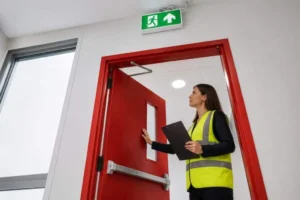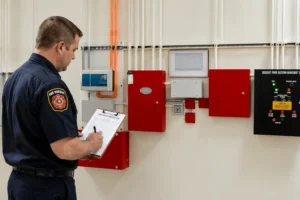
Fire doors play an important role in a building’s fire safety arrangements. When appropriately specified, installed and maintained, they help limit the spread of fire and smoke, protect escape routes and support the building’s fire compartmentation strategy.
For landlords, property managers, managing agents and commercial operators in Essex, understanding the condition of fire doors is an important part of managing premises safely.
OFHSES provides fire door inspection services intended to help property owners and those responsible for building safety identify visible defects, understand inspection findings and determine appropriate next steps. The scope of an inspection depends on the property, the doors being assessed and the requirements agreed for the service.
Whether you manage a residential block, an HMO, a commercial property or another premises where fire doors form part of the fire safety arrangements, a structured inspection can help you understand the condition of those doors and identify issues that may need attention.
Looking to arrange a fire door inspection in Essex? Visit the OFHSES fire door inspection service page or contact the team to discuss your property and requirements.
Professional Fire Door Inspection Services in Essex
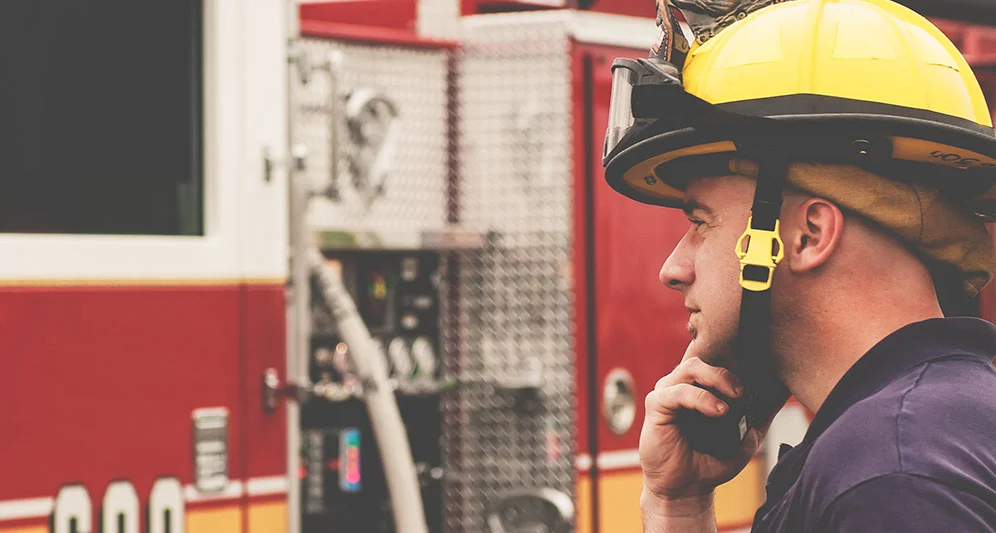
A fire door should be considered as part of a complete doorset, not simply as a door leaf. Depending on its design and location, its performance may depend on the frame, hinges, closing device, hardware, seals where specified, glazing and installation.
Wear and tear, building movement, impact damage, unsuitable alterations or poor maintenance can affect how a door operates. A door that does not close correctly, for example, may not provide the protection expected of it.
A fire door inspection can help property owners and managers understand the visible condition of their doors and identify matters that warrant corrective action or further technical assessment.
OFHSES’s fire door inspection service describes a structured approach to checking door components, recording findings and identifying recommended actions. Confirm the agreed inspection scope before the work begins, particularly where the building has a large number of doors or more complex fire safety arrangements.
Who may need a fire door inspection?
The service may be relevant to:
- Landlords and property investors responsible for maintaining fire doors.
- HMO owners and managers reviewing the condition of doors within their premises.
- Residential block managing agents responsible for communal areas and relevant flat entrance doors.
- Facilities and property managers overseeing fire safety arrangements.
- Commercial property owners and operators.
- Responsible Persons and other parties with relevant control or maintenance responsibilities.
- Housing providers and organisations managing multiple properties.
The appropriate inspection arrangements depend on the building, the doors’ function, the applicable legal duties, the fire risk assessment and any relevant technical requirements.
When Are Fire Door Checks Required in England?
Fire door checking requirements depend on the premises and the applicable legal framework. It is important to distinguish the specific statutory checks introduced by the Fire Safety (England) Regulations 2022 from the wider duties to maintain appropriate fire precautions.
Specific checking duties under the 2022 Regulations
Regulation 10 establishes particular checking duties for qualifying multi-occupied residential buildings in England. For buildings within the relevant scope where the top storey is more than 11 metres above ground level, the Responsible Person must:
- Ensure that fire doors in communal areas are checked at least every three months.
- Use best endeavours to check flat entrance fire doors at least every 12 months.
- Keep a record of the steps taken to check flat entrance doors, including attempts to gain access where access is not granted.
The checks must include the operation of self-closing devices. The regulation also establishes resident information requirements concerning the importance of fire doors, including keeping them shut when not in use, not tampering with self-closing devices and reporting faults or damage.
The threshold relates to the height of the top storey as defined by the regulations, rather than a general description of the building’s total height.
These specific checking intervals must not be applied automatically to every HMO, residential property or commercial premises. Whether the regulation applies depends on the building’s characteristics and legal scope.
Read Regulation 10 of the Fire Safety (England) Regulations 2022 and the official government fire door guidance.
How do the wider fire safety duties apply?
The Regulatory Reform (Fire Safety) Order 2005 establishes wider duties for the Responsible Person, including suitable fire risk assessment and maintenance of fire precautions where necessary to safeguard relevant people.
Article 17 requires relevant premises, facilities, equipment and devices to be subject to a suitable maintenance system and maintained in an efficient state, in efficient working order and in good repair where necessary for safety. The Fire Safety Act 2021 clarified the application of the Fire Safety Order to elements including the structure, external walls and flat entrance doors in relevant multi-occupied residential buildings.
The absence of a specific quarterly or annual checking interval under the 2022 Regulations does not remove other applicable fire safety duties.
| Situation | What to consider |
| Qualifying multi-occupied residential building with a top storey above 11 metres | The specific communal-door and flat entrance door checks under Regulation 10 |
| Residential building below that threshold | Applicable fire risk assessment, maintenance duties and the condition and suitability of fire doors; the specific Regulation 10 checking intervals do not apply in the same way |
| HMO | Applicable fire safety duties, HMO licensing conditions and local authority requirements, taking account of the property’s layout and use |
| Commercial premises | The Fire Safety Order and the building’s risk assessment and maintenance arrangements; do not automatically apply the residential Regulation 10 intervals |
| Building following refurbishment or changes to use | Whether alterations affect the door, frame, compartmentation or fire safety strategy, and whether further assessment is needed |
A fire risk assessment should consider whether fire doors are suitable for their intended purpose. Routine checks help identify deterioration, but they do not replace the assessment of whether the original door specification and installation are adequate.
What Does a Fire Door Inspection Cover?

The exact scope depends on the building, the door specification, the inspection brief and the service agreed. Subject to that scope, an inspection may consider the following areas.
Door leaf and frame condition
The door leaf and frame should be checked for visible damage or deterioration that could affect the door’s operation or intended fire-resisting performance.
Potential concerns include cracks, splits, distortion, impact damage, loose frame sections and holes or modifications that have not been assessed for suitability.
Hinges, latches and hardware
Hinges, fixings, latches, locks and other hardware should be considered in relation to the doorset’s design and intended function.
Loose or damaged components, unsuitable replacements or hardware that prevents the door from closing correctly may warrant further investigation.
Self-closing devices
Where a door is intended to self-close, its closing action is an important consideration. A closer that is damaged, disconnected or unable to close the door fully may affect the door’s effectiveness.
The cause may involve the closer itself, hinges, alignment, floor friction, the latch or other components. The appropriate action depends on the findings.
Gaps, alignment and operation
The clearance between the door leaf and frame can affect how the door performs. The inspection may consider uneven gaps, changes in alignment, rubbing or difficulty closing.
Any measurements must be evaluated against the relevant doorset specification and applicable guidance. A single measurement should not be treated as a universal pass-or-fail rule for every fire door.
Intumescent strips and smoke seals
Where fitted or required by the doorset specification, seals should be checked for visible damage, detachment, obstruction or deterioration.
The absence of a strip or smoke seal does not automatically prove that every existing flat entrance door is unfit for purpose. Government guidance specifically cautions against assuming that an older door must be replaced solely because it lacks components associated with newer doors. Suitability must be assessed in context.
Glazing, letterboxes and other modifications
Where present, glazing, letterboxes, locks, cable openings and other components should be considered for visible damage or changes that could affect the door’s performance.
A replacement component should be suitable for the doorset. Unassessed modifications may need further technical review.
Labels, specifications and available records
Available door identification, product information, installation details and maintenance records can help clarify the door’s intended use and support the review of findings.
However, documentation and physical condition are separate considerations. Missing paperwork does not automatically prove that a door is defective, and paperwork alone cannot demonstrate that a damaged door remains suitable.
A visual inspection also has limits: it cannot necessarily establish every aspect of the door assembly’s fire resistance or verify concealed installation details.
Fire Door Defects an Inspection May Identify
A structured inspection may identify a range of issues, depending on the condition and type of door.
| Potential finding | Why it may matter | Possible next step |
| Damaged door leaf or frame | May affect the door’s integrity or fit | Assess the damage and establish whether suitable repair or replacement is needed |
| Faulty self-closing device | The door may not close as intended | Investigate the cause and arrange appropriate corrective work |
| Gaps or alignment problems | May affect the door’s intended performance | Check the relevant specification and correct the underlying issue where necessary |
| Damaged or detached seals | May affect the intended function of components where fitted | Confirm the required components and arrange suitable repair |
| Loose or unsuitable hardware | May interfere with alignment, latching or closing | Check compatibility and have the issue corrected appropriately |
| Door obstructed or wedged open | May prevent a door required to be closed from performing its intended role | Remove inappropriate obstructions and address the underlying management issue |
| Unassessed alterations | May affect the doorset’s intended fire performance | Establish what was changed and whether further technical assessment is required |
| Incomplete inspection or maintenance records | Makes it harder to track checks, defects and corrective actions | Reconstruct available records and introduce a suitable recording process |
These are examples of issues an inspection may identify, not a ranking of the most common defects in Essex. The significance of each finding depends on the door, its intended function and the circumstances.
For a more detailed explanation of individual defects, read Common Fire Door Failures Identified in UK Inspections.
Fire Door Inspections for HMOs and Residential Blocks in Essex
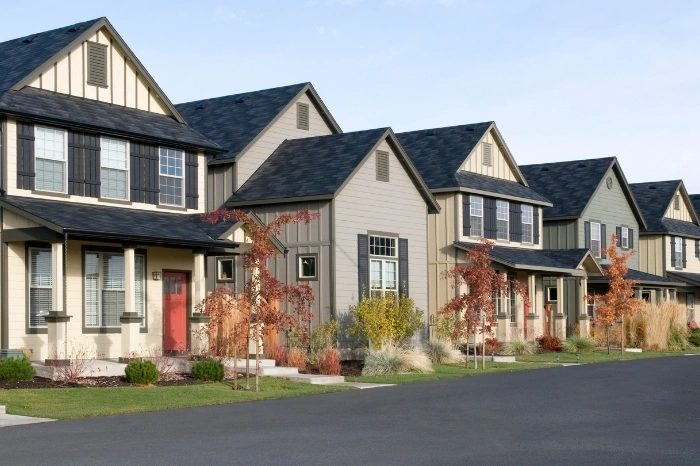
HMOs and residential blocks can have different fire safety arrangements depending on their layout, number of occupants, shared areas, building height, means of escape and applicable legal requirements.
Landlords and managing agents should establish which duties apply to their specific premises rather than assume that every property follows the same checking schedule.
HMOs
HMO fire safety may involve fire doors, protected escape routes, fire detection and warning systems, and other measures appropriate to the premises. The relevant requirements can depend on the property, its licence conditions and local authority requirements.
A fire door inspection can help identify door-related issues, but it does not establish that the HMO satisfies every licensing or fire safety requirement.
For more information, see HMO Fire Compliance in London: What Landlords Should Prepare For and HMO Fire Safety Requirements: What Landlords Must Know.
Residential blocks
In qualifying multi-occupied residential buildings in England, the Responsible Person must understand the specific Regulation 10 duties and maintain appropriate records of the required checks.
Residential blocks may also need broader reviews of their fire risk assessment, door suitability and maintenance arrangements. Routine checks are important, but they should not be confused with a more detailed assessment of the door’s specification or installation.
Fire Door Inspections for Commercial Premises
Offices, retail units, warehouses, industrial premises and other commercial buildings may use fire doors to protect escape routes, separate areas or support compartmentation.
The appropriate inspection and maintenance arrangements depend on the premises, its fire risk assessment, the door’s function and the relevant technical requirements.
Commercial property managers should pay particular attention to doors affected by:
- Changes to the building layout or use.
- Refurbishment or installation work.
- Repeated impact or heavy use.
- Changes to access control or door hardware.
- Damage that affects closing action or the door’s fit.
- Maintenance issues that remain unresolved.
The specific quarterly and annual checking intervals in Regulation 10 should not automatically be applied to commercial premises simply because the building contains fire doors. Other applicable fire safety and maintenance duties remain important.
Why Fire Door Inspection Reports and Records Matter
A useful inspection report can help the person responsible for the building understand what was checked, what was found and what action may be needed.
Depending on the agreed scope, the report may record:
- The doors or locations included in the inspection.
- The condition observed and the defects identified.
- Photographs supporting relevant findings, where included.
- Recommendations for corrective action.
- The priority assigned to actions, where the service includes risk categorisation.
- Outstanding actions and follow-up requirements.
These records can support maintenance planning, allocation of responsibility and tracking of completed work. They can also help demonstrate the steps taken to manage identified issues where relevant.
It is important to distinguish a physical defect from a documentation gap. An excessive door gap is a condition of the door; a missing inspection record is a record-keeping issue. Both may need attention, but they are not interchangeable.
Licensing, enforcement and insurance consequences depend on the applicable requirements and circumstances. Missing records alone do not establish a particular outcome.
Why Choose OFHSES for Fire Door Inspection in Essex?
OFHSES advertises fire door inspection services supported by structured findings and reporting. Its service page describes checks covering door leaves and frames, seals, hinges and hardware, self-closing devices, gaps and available door identification or certification information.
The published service information also describes door-by-door findings, photographic evidence and prioritised corrective actions. Confirm the exact deliverables and inspection scope with OFHSES before booking, particularly if your project requires a particular report format or specialist technical assessment.
For property owners and managers, a clearly defined inspection scope can help establish what will be checked, how findings will be recorded and what happens if further investigation or remedial work is needed.
An inspection does not automatically guarantee compliance with every applicable legal or technical requirement. The findings should be considered alongside the building’s wider fire safety arrangements and any actions arising from the fire risk assessment.
To review the advertised service, visit the OFHSES fire door inspection page.
Arrange a Fire Door Inspection in Essex
If you manage a property in Essex and need to review the condition of its fire doors, contact OFHSES to discuss the building and the scope of inspection required.
When making an enquiry, it may help to provide:
- The property’s location and type.
- The approximate number of fire doors.
- The building’s height and layout, where relevant.
- Whether the doors are in communal areas, individual dwellings or commercial areas.
- Any known defects or recent alterations.
- Existing inspection records or findings that need follow-up.
This information can help clarify the proposed scope and identify whether further details are needed before the inspection is arranged.
Contact OFHSES
- Telephone: +44 743 475 7514
- Email: hello@ofhses.com
- Service information: Fire Door Inspection
Discuss your property and inspection requirements with the team before assuming that a particular inspection interval or service scope applies.
Frequently Asked Questions
When are fire door checks legally required in England?
The Fire Safety (England) Regulations 2022 establish specific duties for qualifying multi-occupied residential buildings. Where the top storey is more than 11 metres above ground level, communal fire doors must be checked at least every three months, and the Responsible Person must use best endeavours to check flat entrance fire doors at least every 12 months. Other fire safety and maintenance duties may apply outside this specific scope.
Do all buildings over 11 metres require quarterly fire door checks?
No. The specific Regulation 10 checking duties concern qualifying multi-occupied residential buildings within the scope of the regulations. The threshold relates to the top storey height as defined in the legislation. It is not a universal quarterly inspection rule for every building over that height.
How often should fire doors be inspected in smaller buildings?
There is no single interval in Regulation 10 that automatically applies to every smaller building. The Responsible Person must still address applicable fire safety and maintenance duties. Appropriate checks and maintenance should be established in light of the building’s fire risk assessment, door function, condition and relevant technical requirements.
What is checked during a fire door inspection?
Depending on the scope, checks may include the door leaf, frame, hinges, hardware, closing action, gaps, seals where specified, glazing and visible alterations. Available labels, specifications and records may also be reviewed. The agreed scope should clarify what is included and whether further technical assessment is available.
Are fire door inspections required for HMOs?
Fire doors may form part of an HMO’s fire safety arrangements, but the specific duties and inspection arrangements depend on the premises and applicable requirements. HMO licensing conditions and local authority requirements may also be relevant. A fire door inspection alone does not establish that the entire HMO meets its obligations.
Do commercial premises follow the same inspection intervals as qualifying residential buildings?
Not automatically. The quarterly communal-door and annual best-endeavours flat entrance door checks are specific to qualifying residential buildings under Regulation 10. Commercial premises remain subject to applicable fire safety duties, including appropriate maintenance of relevant fire precautions.
What happens if a fire door defect is identified?
The finding should be recorded, its significance considered and appropriate corrective action arranged. Depending on the issue, this may involve adjustment, suitable repair, component replacement or replacement of the doorset. More complex defects may require further assessment by a competent specialist.
What should a fire door inspection report include?
The contents depend on the agreed service. A useful report may identify the doors inspected, describe observed defects, include photographs where appropriate, recommend corrective actions and record priorities or follow-up needs where these are part of the service. Confirm the expected deliverables before booking.
Can a fire risk assessment identify the need for further fire door checks?
Yes. A suitable fire risk assessment should consider whether the fire doors are adequate for their intended purpose and whether fire precautions need attention. Routine checks help identify deterioration, but they do not replace the assessment of door suitability or the need for further technical investigation.
Does a fire door inspection guarantee compliance?
No. An inspection provides findings within its agreed scope. Overall compliance depends on the applicable legal requirements, the building’s fire risk assessment, the suitability and condition of relevant fire doors, and whether required corrective actions are completed.
Arrange Your Fire Door Inspection
Fire doors form part of a wider fire safety system, and their condition should be managed in line with the needs of the building and the duties that apply to it.
If you need help understanding the condition of fire doors at a property in Essex, contact OFHSES to discuss your requirements and confirm the appropriate inspection scope.