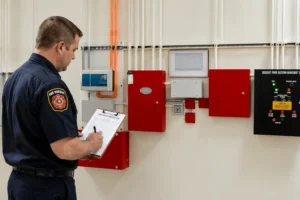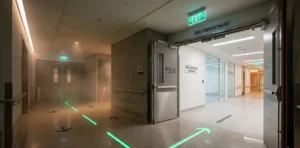
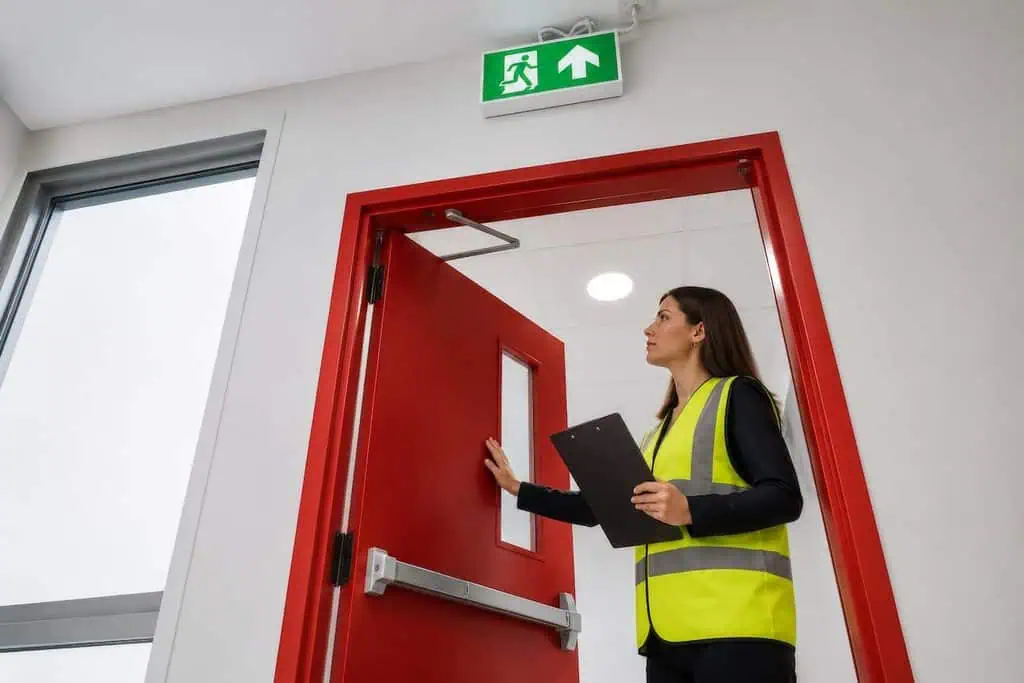
If you run a workplace, manage a commercial building or look after the shared areas of a block of flats, the fire risk assessment regulations place a legal duty on you personally. It does not sit with your insurer, your alarm contractor or the fire and rescue service. It sits with a defined person, the Responsible Person, and it does not end when the first report is signed. The assessment must be suitable, recorded and kept up to date.
This guide sets out what the law says, who it applies to, how often an assessment must be reviewed, who can carry one out and what enforcement looks like. It keeps legal requirements and good practice apart, because many websites blur them.
Which law applies? The main legislation, the Regulatory Reform (Fire Safety) Order 2005, extends to England and Wales only. Scotland and Northern Ireland have separate regimes, so a search for “fire risk assessment UK” can surface rules that do not apply to your premises. This guide covers England and flags where Wales differs.
What Is a Fire Risk Assessment?
A fire risk assessment is a structured examination of a building that identifies what could start a fire, who could be harmed and whether the precautions in place are adequate. In law, its purpose is to identify the “general fire precautions” the Responsible Person must take (Article 9(1)).
It protects “relevant persons”: anyone lawfully on the premises, including employees, visitors, contractors and residents, plus anyone nearby who is at risk from a fire there. It is not a certificate. It is a working document that should lead to an action plan.
Are Fire Risk Assessments Legally Required in the UK?
In England and Wales, yes, for almost every building other than a private home. Under the Regulatory Reform (Fire Safety) Order 2005, the Responsible Person must make a “suitable and sufficient” assessment of the risks to relevant persons. Scotland and Northern Ireland impose assessment duties through separate legislation.
Three points in Article 9 are often missed:
- There is no standard template. The assessment must fit the premises, its use and its occupants.
- It must be kept up to date. Article 9(3) requires regular review (see below).
- It must be recorded. Since 1 October 2023, every assessment and review must be recorded, whatever the number of employees. Older guidance linking recording to five or more employees is out of date.
You do not have to send the assessment to the fire service. An enforcing authority can, however, require you to produce your records during an inspection (Article 27).
Which Fire Risk Assessment Regulations Apply in England and Wales?
The framework is a core Order with later layers. In plain terms:
- Regulatory Reform (Fire Safety) Order 2005. The foundation. It sets the Responsible Person’s duties, including general fire precautions, the risk assessment, maintenance, training and cooperation between duty-holders.
- Fire Safety Act 2021. It confirmed the Order covers the structure, external walls (including balconies, windows and doors in them) and flat entrance doors of buildings with two or more sets of domestic premises. It took effect in England on 16 May 2022.
- Fire Safety (England) Regulations 2022. These add duties for multi-occupied residential buildings, including information for residents and routine fire door checks. Duties increase in taller buildings. Our guide to UK fire safety regulations for landlords covers the 2022 changes.
- Building Safety Act 2022, section 156. From 1 October 2023 it requires full recording of assessments, adds duties for Responsible Persons to identify and coordinate with each other, and requires records to pass to a new Responsible Person. It also requires cooperation with “accountable persons” in higher-risk residential buildings.
- Article 9A (competence). The Act provides that a Responsible Person must not appoint someone to assist with an assessment unless they are competent. That provision is not yet in force. Competence still matters in practice (see below).
- Wales. The Building Safety (Wales) Act 2026 amends the Order in Wales and is being brought into force in stages. Welsh premises should check Welsh Government guidance.
Guidance published under Article 50 is not law in itself, but it is the government’s own statement of how to meet the duties. The GOV.UK collection is the sensible benchmark.
Who Is the “Responsible Person”?
Under Article 3, the Responsible Person is:
- In a workplace: the employer, if the workplace is to any extent under their control.
- In other premises: the person who controls them in connection with a trade, business or other undertaking. If that person has no such connection, the owner.
Responsibility can overlap. Anyone with some control, including through a contract or tenancy obligation for maintenance, repair or safety, carries the duties for the matters within their control (Article 5). Where several Responsible Persons share a building, they must identify each other, share contact details, record who covers which part and coordinate (Article 22).
Consider a freeholder who owns a block of six flats above a shop. The freeholder, a managing agent and the shop tenant may each hold duties for different parts. The law expects those arrangements to be written down, not assumed.
You can appoint competent people to help, but you cannot hand the legal duty away. Article 32(11) says the Order gives an employer no defence based on the act or default of an employee or an appointed person. A managing agent or consultant can do the work, but the Responsible Person remains answerable. For landlords, our guide to HMO fire compliance in London shows how this works in multi-occupied property. GOV.UK’s People with duties under fire safety laws is the official starting point.
Which Buildings Need a Fire Risk Assessment?
All non-domestic premises, and the shared parts of multi-occupied residential buildings. Private single dwellings are excluded (Article 6).
| Premises | Position | GOV.UK starting point |
| Offices and shops | Workplace: covered | Offices and shops |
| Factories and warehouses | Workplace: covered | Factories and warehouses |
| Hotels, B&Bs, hostels | Covered | Sleeping accommodation |
| Care homes | Covered | Residential care premises |
| Schools and colleges | Covered | Educational premises |
| Blocks of flats | Common parts, structure, external walls and flat entrance doors | Purpose-built blocks of flats |
| Single private dwelling | Not covered by the Order | n/a |
HMOs need care. Houses in multiple occupation are also regulated through the Housing Act 2004 (including the Housing Health and Safety Rating System) and the Management of Houses in Multiple Occupation (England) Regulations 2006. How the Order applies depends on layout and occupation. Our guide to HMO fire safety requirements explains what landlords need to prepare.
For care homes, the assessment must reflect residents who cannot evacuate unaided. Our explainer on progressive horizontal evacuation shows one strategy used in that setting. If your premises are in east London or Essex, see our guide to fire risk assessment in Romford.
What Does a Fire Risk Assessment Cover?
The assessment must be suitable and sufficient for the specific premises, so a small shop and a care home will look very different. Government guidance frames it as five steps: identify hazards, identify people at risk, evaluate and reduce the risk, record and plan, then review.
In practice a competent assessment examines:
- Hazards: ignition sources, fuel sources and anything that spreads fire.
- People at risk: including lone workers, sleeping occupants and anyone needing help to escape. The Order requires the assessment to identify groups especially at risk (Article 9(7)). GOV.UK has guidance on means of escape for disabled people.
- Means of escape: routes, exits and signage (Article 14).
- Detection, warning and emergency lighting: whether they are adequate and tested.
- Fire-fighting equipment: suitable for the premises and easy to reach.
- Fire doors and compartmentation: whether doors, seals, closers and fire-stopping can do their job. See our guides to fire door inspection in Essex and common fire door failures.
- Emergency procedures and training: who does what, and whether staff know it.
- Maintenance: a system for keeping safety measures in working order (Article 17).
The result should be a prioritised action plan. A report that lists faults without owners or deadlines is not much use.
How Often Should a Fire Risk Assessment Be Reviewed?
The law sets no fixed interval. Article 9(3) requires the assessment to be reviewed “regularly so as to keep it up to date”. It must be reviewed particularly if there is reason to suspect it is no longer valid, or if there has been a significant change in what it covers. That includes significant changes, extensions or conversions to the premises or to the organisation of work. If the review shows changes are needed, you must make them.
| Legal requirement | Good practice | |
| Interval | Regular, to keep it up to date | Many assessors recommend a scheduled review at least annually; higher-risk premises more often |
| Triggers | Reason to suspect it is invalid; significant change | Change of use, refurbishment, new tenants, alarm upgrades, staffing changes, incidents or near misses |
| Record | Every assessment and review recorded | Dated action log with owners |
The “annual renewal” idea is professional practice, not a statutory deadline. Equally, an out-of-date assessment is a breach whatever the calendar says. Fire and rescue service enforcement records show failure to review the assessment is a recurring finding. Our guide on how often a fire risk assessment should be reviewed covers practical triggers in more detail.
If you are unsure whether your current assessment still reflects how the building is used, a competent professional review can identify gaps and prioritise corrective action. [Service link to add: Fire Risk Assessment page]
Who Can Carry Out a Fire Risk Assessment?
The law requires a competent person. It does not name a mandatory qualification. For simple premises, the Responsible Person may complete the assessment themselves using government guidance if they are competent. For complex premises, specialist input is usually the safer route.
Competence under Article 18 means sufficient training, experience or knowledge and other qualities to assist properly with the preventive and protective measures. In practice that means:
- understanding the premises and how it is used
- knowing the relevant legislation and guidance
- spotting hazards and judging risk
- recommending proportionate measures and communicating them clearly
Good practice when appointing a provider:
- Ask for experience with similar premises.
- Ask which methodology they follow (PAS 79-1 and PAS 79-2 are widely used).
- Ask whether they hold third-party certification.
- Check professional indemnity insurance.
- Ask for a sample report.
The National Fire Chiefs Council publishes guidance on finding a competent fire risk assessor. Fire and rescue authorities do not carry out assessments on behalf of the Responsible Person. If you need a fire safety consultant for a complex site, a block of flats or sleeping accommodation, [Service link to add: Fire Safety Consultancy page].
What Happens If Fire Safety Requirements Are Not Met?
Enforcement is usually led by the local fire and rescue authority (Article 25). Inspectors can enter premises, inspect them and require records. The main tools are:
- Enforcement notice: requires named failures to be remedied within a set period of at least 28 days.
- Alterations notice: where premises pose, or could pose, a serious risk.
- Prohibition notice: restricts or stops use of the premises. It takes effect immediately if the authority considers there is an imminent risk of serious personal injury.
Notices can be appealed to a magistrates’ court within 21 days. An appeal suspends an enforcement or alterations notice, but not a prohibition notice unless the court directs (Article 35).
Failing to comply with a duty can also be a criminal offence where the failure places people at risk of death or serious injury in case of fire. Failing to comply with an enforcement notice is an offence too. On conviction on indictment, penalties include a fine, imprisonment of up to two years, or both (Article 32). Directors and managers can be personally liable where an offence is attributable to their consent, connivance or neglect. The government’s guide on enforcement and sanctions was updated on 3 July 2026.
Beyond the law, a prohibition notice can close a premises, and the real cost of a fire falls on the people inside it.
Why Fire Risk Assessment Still Matters
In the year ending March 2026, fire and rescue services in England attended 170,597 fires, 19% more than the previous year. Most of that rise came from outdoor and secondary fires after a hot, dry summer, so it says little about buildings. The building-specific figures are 39,859 fires in dwellings and other buildings, and 254 fire-related fatalities in 239 fatal fires, of which 184 deaths were in dwellings.
These figures describe fires attended in England, not the effect of any individual assessment. What they show is that fires in buildings remain common and sometimes fatal. The assessment is the legal mechanism for managing that risk before an emergency, not during it.
Fire Risk Assessment Regulations: FAQs
Is a fire risk assessment a legal requirement in the UK?
In England and Wales, yes, for almost all premises except private single dwellings, under the Regulatory Reform (Fire Safety) Order 2005. Scotland and Northern Ireland have separate legislation.
Who is responsible for a fire risk assessment?
The Responsible Person: usually the employer or the person controlling the premises, or the owner where no business control exists. More than one person can share duties.
How often should a fire risk assessment be reviewed?
The law requires regular review to keep it up to date, and a review after significant change or if it may no longer be valid. There is no fixed statutory interval. Annual review is common practice.
Who can carry out a fire risk assessment?
A competent person. The law does not require one particular qualification. Competence means sufficient training, experience, knowledge and other qualities for the premises concerned.
What does a fire risk assessment include?
Hazards, people at risk, means of escape, detection and warning, emergency lighting, fire-fighting equipment, fire doors, procedures, training and maintenance, with a recorded action plan.
Do landlords need a fire risk assessment?
Where the building has shared areas or contains two or more sets of domestic premises, usually yes: the Order covers common parts, structure, external walls and flat entrance doors. A single private dwelling is excluded. HMOs have additional housing law duties.
What happens if a fire risk assessment is not carried out?
The enforcing authority can serve notices, including a prohibition notice, and prosecute where the failure places people at risk of death or serious injury in case of fire.
When should a fire risk assessment be updated?
After significant changes to the building, its use or occupancy, the fire safety systems or work organisation, after a fire or near miss, or whenever there is reason to think it no longer reflects reality.
Conclusion
The fire risk assessment regulations are less about paperwork than about keeping a live, recorded understanding of how fire could harm people in your building. The Responsible Person must assess, record, act and review. No single qualification is legally mandated, but competence is expected, and responsibility cannot be passed on by appointment alone. If you are not sure your assessment is suitable and sufficient, or you have taken on a new building, speak to OFHSES. A competent assessor can review your current documents, assess the premises on site and give you a prioritised action plan