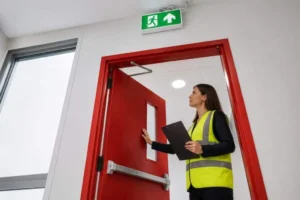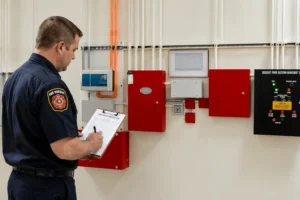
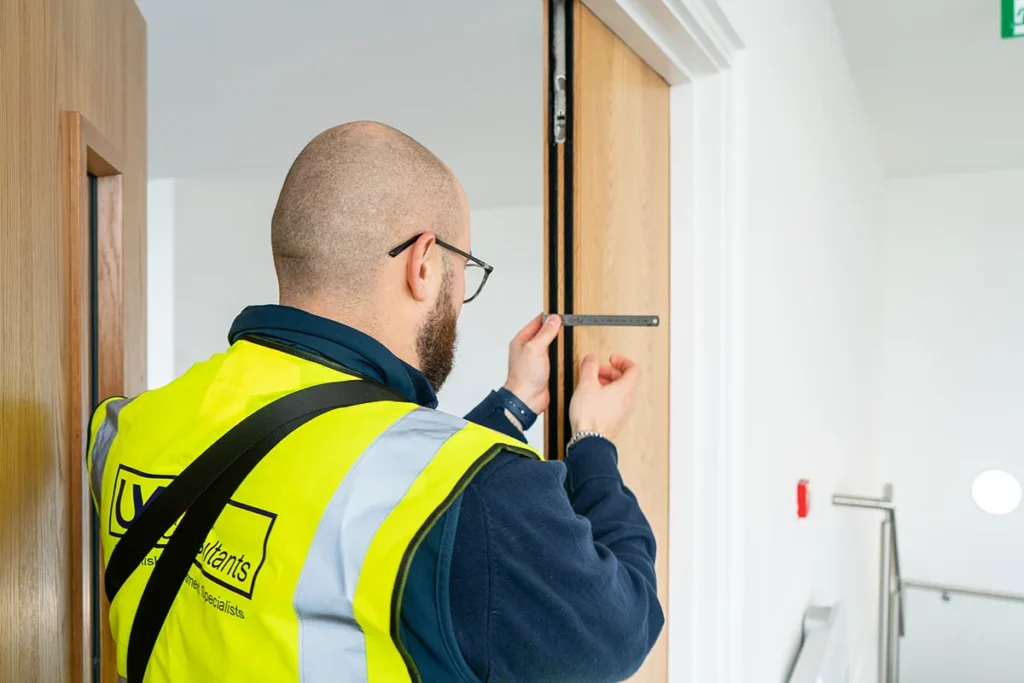
A fire door inspection is a structured check of a fire door and everything that makes it work: the leaf, frame, hinges, seals, closer, hardware, glazing and signage. The inspector records what they find and tells you what needs to happen next.
This guide walks through the visit step by step. It also explains where the law stops and professional good practice begins, because the two are often confused.
What Is a Fire Door Inspection?
A fire door inspection is a competent, recorded examination of a fire doorset to check that it is in a condition to do its job. That job is to resist fire and smoke for a period of time and, in most cases, to close fully on its own every time it is used.
It covers the whole assembly, not just the door slab. A sound leaf in a damaged frame, or a good frame with a missing closer, can compromise the doorset.
Why Are Fire Door Inspections Important?
Fire doors are a passive fire protection measure. In a building designed around compartmentation, they are intended to:
- Hold back fire and smoke within the compartment where it starts
- Protect escape routes such as corridors and stairwells
- Slow the spread of fire between areas
- Give occupants more time to leave and support the building’s evacuation strategy
A fire door will not stop a fire or smoke by itself, and it only performs as intended if it is in good condition and closes properly. Doors take daily wear. They get wedged open, repainted, drilled for new hardware or knocked by trolleys, and most of those changes happen without anyone thinking about fire safety.
Fire still kills in England. Home Office statistics record 254 fire-related fatalities in the year ending March 2026, with 72% of those deaths in dwelling fires. Doors are only one part of the picture, but they are one of the most visible and most easily damaged parts of a building’s fire protection.
Is a Fire Door Inspection a Legal Requirement?
It depends on the building. This is the part most articles skip, so it is worth being precise. There are four layers.
Legal requirement (all non-domestic premises and the common parts of blocks of flats). Under the Regulatory Reform (Fire Safety) Order 2005, the responsible person must carry out a fire risk assessment and keep fire precautions maintained. The Order does not set a fixed inspection interval for fire doors. How often they are checked is shaped by the risk assessment and by the Order’s maintenance duty.
Legal requirement (certain residential buildings in England). The Fire Safety (England) Regulations 2022 came into force on 23 January 2023. Under regulation 10, in blocks of flats where the top storey is more than 11 metres above ground level (typically more than four storeys), GOV.UK guidance says the responsible person must use best endeavours to check flat entrance fire doors at least every 12 months, and check fire doors in communal areas at least every three months. In all blocks containing two or more flats, residents must be given fire door information (keep doors shut, don’t tamper with self-closers, report faults).
Two points about these statutory checks. They are intended to be simple and visual, and the guidance says that, with instruction, caretakers, managing agents or maintenance staff should be able to do them without a specialist. And the Regulations apply to England only. Duties in Wales, Scotland and Northern Ireland differ, so check the position for your premises.
Government guidance. The same GOV.UK guidance notes that these simple checks don’t replace periodic assessment of fire doors by fire safety specialists, for example on a sampling basis during fire risk assessments.
Standards and good practice. BS 8214:2016 is a code of practice that gives recommendations for the specification, installation and maintenance of timber-based fire doors. It is a recommendation, not law, and it doesn’t cover every door type. Metal and composite doorsets have their own considerations. Anything beyond the statutory checks, such as a full professional inspection or fire door survey, is generally good practice or a professional recommendation, often triggered by a risk assessment finding.
In short, a professional fire door inspection is usually not what the law prescribes in a fixed interval. It is how many responsible persons demonstrate they are maintaining fire doors properly.
What Actually Happens During a Fire Door Inspection?
The exact process depends on the doorset, the premises and what the client has asked for. A typical inspection of a hinged timber fire door follows this order.
1. Identifying the Fire Door
The inspector starts by establishing what they are looking at: where the door is, what it protects, its type and rating where this can be identified (for example FD30 or FD60), and what the doorset consists of. They note whether the door is a self-closing door, a hold-open door or a keep-locked door, and look at the compartmentation around it.
Certification labels, plugs or markings can help identify the door. Their absence isn’t always a failure. The GOV.UK guidance says that for existing flat entrance doors, missing intumescent strips, smoke seals or certification does not imply the door is unfit for purpose, and that adequacy is a matter for the fire risk assessment. The inspector records what is there and flags what can’t be verified.
2. Inspecting the Door Leaf
The leaf is checked for splits, cracks, holes, warping, delamination, damage to edges and signs of impact. They also look for unauthorised modifications such as cut-outs for vents, letterboxes or glazing, and holes where hardware has been removed. Damage matters because it can open a path for fire and smoke, and because modifications can undermine how the door was designed and tested.
3. Checking the Door Frame
The frame is examined for damage, loose fixings, open joints, movement and misalignment. The inspector also checks that the frame and leaf are compatible and that the frame is properly sealed to the surrounding wall. A frame that has moved can make a door close badly even when the leaf looks fine.
4. Checking the Hinges
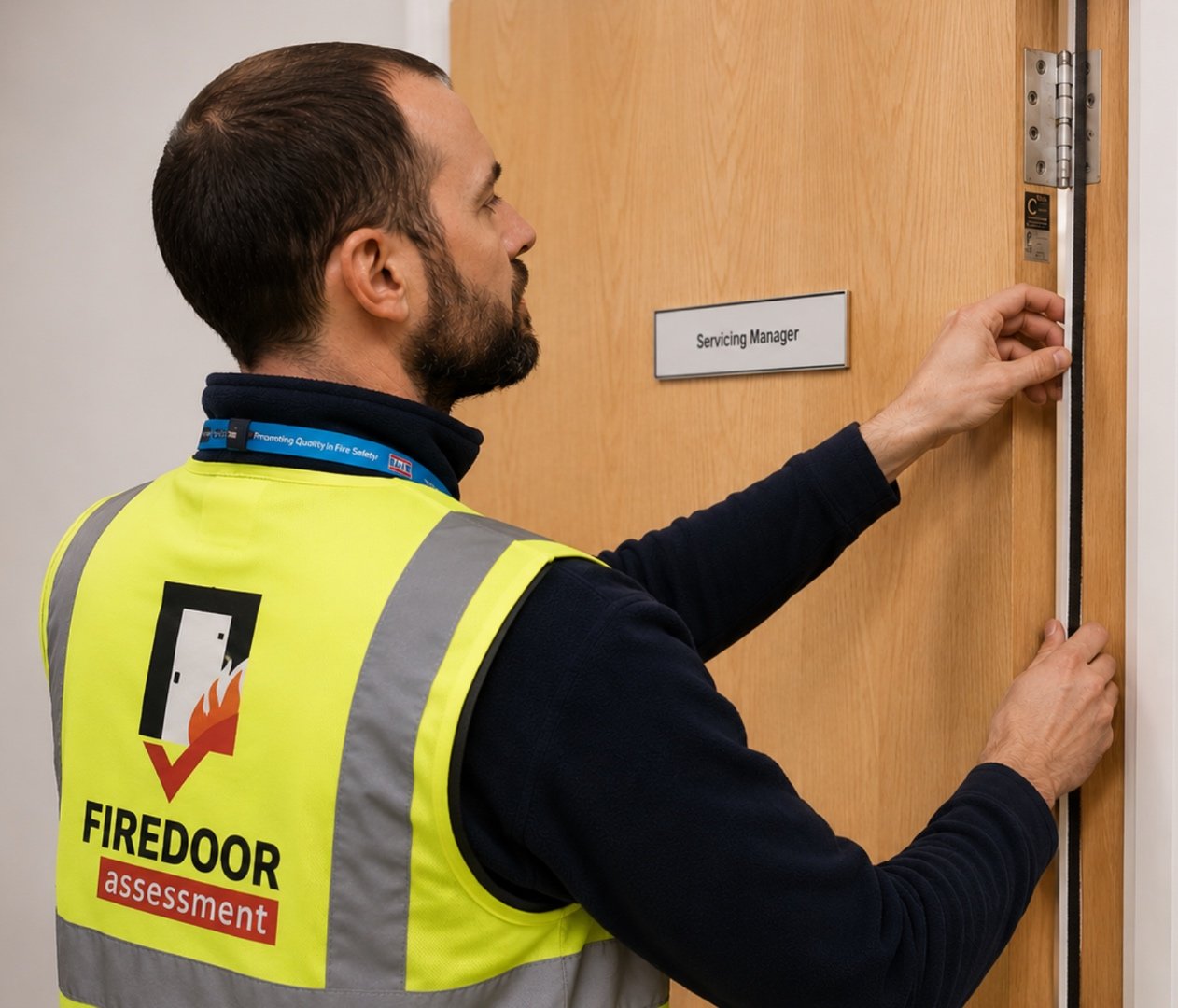
Hinges should be present, secure, undamaged and appropriate for the door. The inspector looks for missing or loose screws, wear, corrosion and signs the door is dropping. There is no universal number of hinges. The correct arrangement depends on the doorset and the manufacturer’s or test evidence, so the inspector works from what the specification requires.
5. Checking Intumescent Strips and Smoke Seals
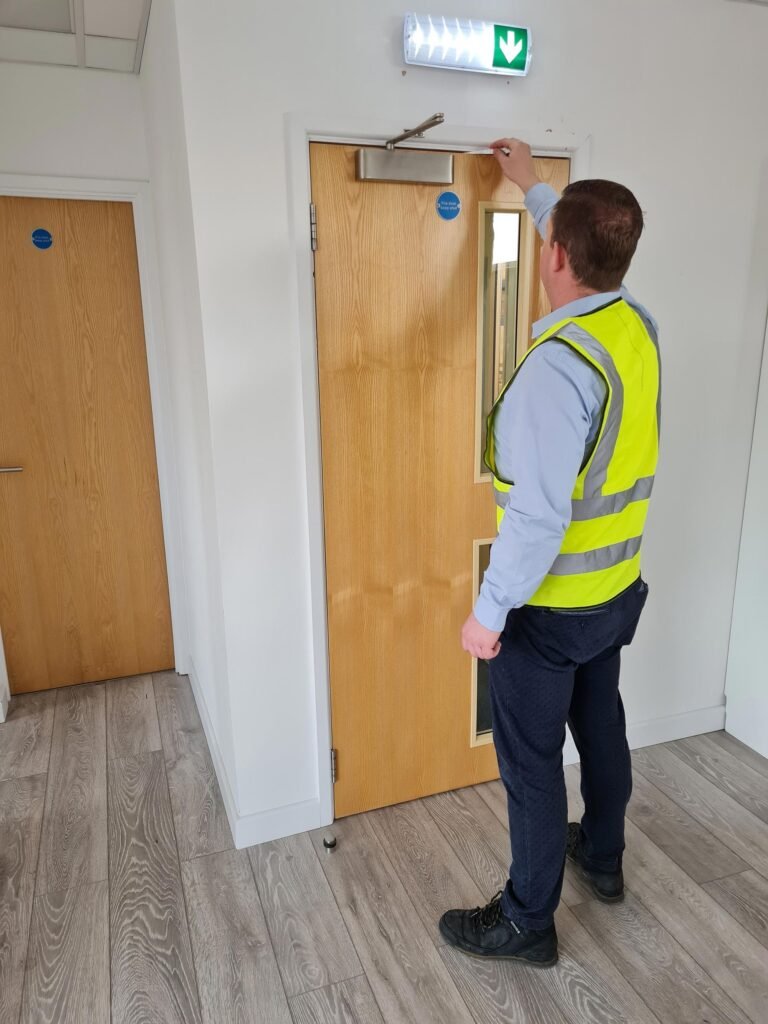
Intumescent strips expand when heated to seal the gap around the door in a fire. Smoke seals, which resemble draught seals, limit the passage of cold smoke. They are often combined in a single strip fitted to the door or frame.
The inspector checks that they are present where they should be, continuous, undamaged, correctly positioned, in contact with the door edge or frame, and not painted over or obstructed. Painting over is one of the most common issues found after redecoration.
6. Checking Gaps and Alignment
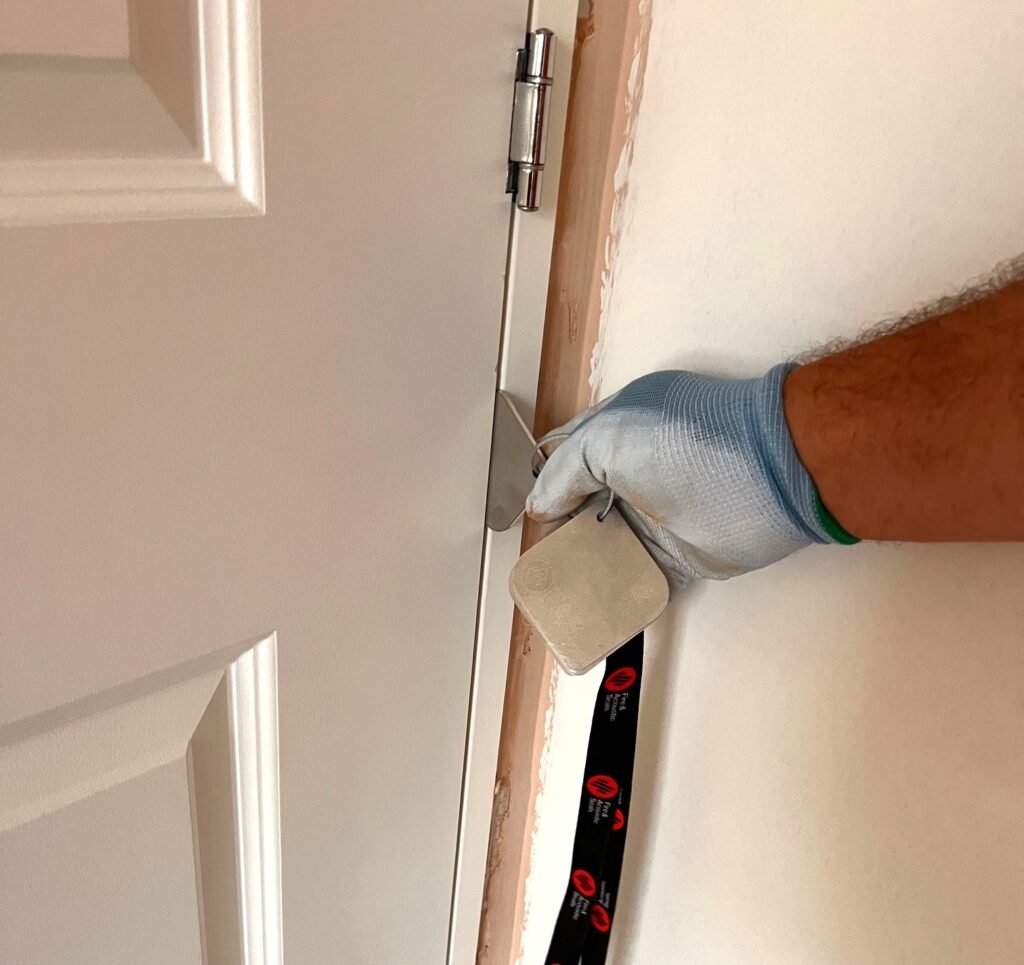
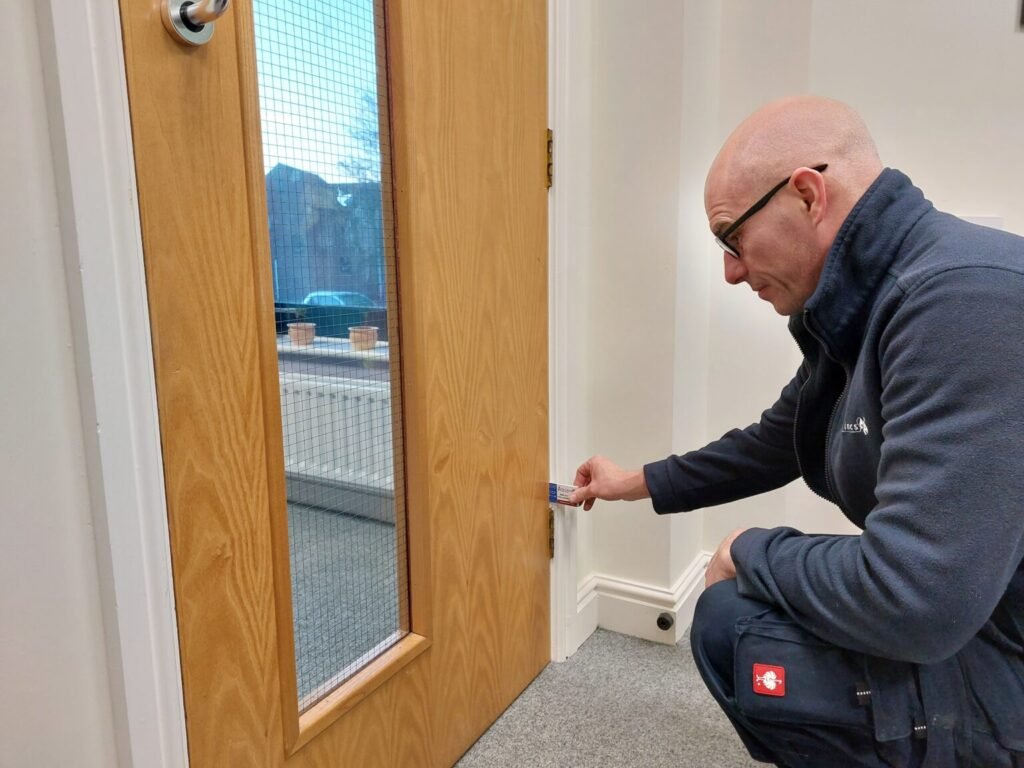
Gaps around the leaf matter because fire and smoke find them. The inspector checks gaps between leaf and frame, the threshold gap, whether gaps are even, and whether the door closes squarely.
On measurements, GOV.UK’s guidance for the routine checks in blocks of flats describes an industry standard that gaps should not exceed 4 mm, except at the bottom of the door, where the gap should be as small as practicable without the door snagging. For a specific doorset, the manufacturer’s instructions and test evidence set the tolerances, so a professional inspector works from those where they are available.
7. Checking the Door Closer
A fire door that does not close fully cannot do its job. The inspector checks that a closer is present, secure, undamaged and suitable for the door, and that the door closes completely and latches from different opening angles. The GOV.UK guidance suggests opening the door fully, letting go, then opening it to roughly 15 degrees and letting go again. In both cases the door should close fully into its frame.
A door might look intact and still need attention because it stops a few millimetres short of the latch, or because a closer has been removed to stop it slamming.
8. Checking Locks, Latches and Hardware
Locks, latches, handles, panic hardware, electromagnetic hold-open devices and other ironmongery are examined for condition, operation and compatibility. Hardware must be suitable for use on a fire door and fitted properly. Hold-open devices linked to the fire alarm should release the door when they are meant to, and they should be tested using the manufacturer’s test method, not by pulling the door off the magnet.
9. Checking Glazing and Vision Panels
Where a door has glazing, the inspector checks the fire-rated glass, beading, seals and general condition, and looks for signs of inappropriate replacement. Ordinary glass is not acceptable in a fire-rated doorset, and mismatched or replaced beads are a common warning sign.
10. Checking Signage
Signage depends on the type of door. Typical examples are “Fire door keep shut”, “Fire door keep locked” and “Automatic fire door keep clear”. The inspector checks that signs are present where appropriate, legible and correct for how that door is used.
11. Checking Surrounding Conditions
Finally, the inspector looks beyond the door: wedges or door stops holding it open, obstructions, damaged adjacent walls, unsealed penetrations near the frame and unauthorised alterations. A good door in a compromised wall is still a weakness in the compartment.
Example: Inspecting an Office Fire Door
Take a fire door between an open-plan office and a corridor that forms part of the escape route. A typical visit might go like this:
- The inspector identifies the door, notes its location, checks for a rating label and gives it a reference number.
- They examine the leaf for damage and alterations.
- They inspect the frame and its fixing to the wall.
- They check the hinges and fixings.
- They check the intumescent strip and smoke seal around the door and frame.
- They check the gaps, including the threshold.
- They test the closer from a wide and a narrow angle.
- They check the latch engages fully.
- They check the signage.
- They photograph any defects.
- They record findings against the door reference.
- They recommend remedial action and a priority.
The precise process depends on the doorset, the premises and the applicable requirements.
How Are Defects Recorded?
A useful inspection report should let the responsible person understand what needs to happen, without needing to be a fire door expert. It will typically include:
- A door reference and its location
- A description of each defect
- Photographs
- A consideration of severity or risk
- A recommended corrective action
- A priority level
- The date of the inspection
Reports are most helpful when they separate quick fixes (a loose hinge screw, a painted-over seal) from items that need further investigation or replacement.
What Happens After the Inspection?
The usual sequence is:
- The inspection is completed.
- Findings are recorded.
- Defects are identified and described.
- A report is issued.
- Remedial actions are recommended.
- Repairs or replacements are arranged.
- Significant issues are prioritised.
- A follow-up inspection takes place where appropriate.
- Records are kept and reviewed.
An inspection is not the same as remedial work. The inspector tells you what is wrong. The repairs are done separately, by a competent contractor, and GOV.UK guidance on the statutory checks says repair or replacement work must be carried out by a competent contractor as soon as reasonably practicable.
Common Fire Door Failures
Certain defects appear again and again, from damaged or painted-over seals to missing closers and excessive gaps. OFHSES has covered these in more detail in common fire door failures identified in UK inspections.
What If My Fire Door Fails?
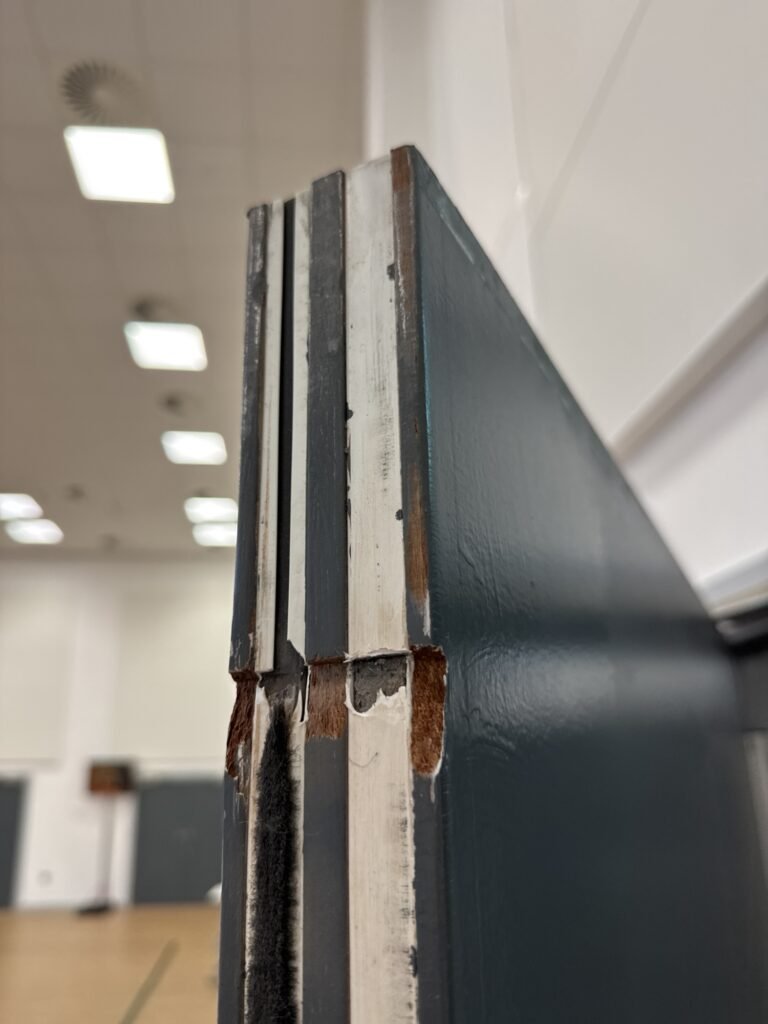
A defective fire door shouldn’t be ignored, but it also doesn’t automatically need replacing. Defects should be assessed and prioritised. A missing screw or a painted-over seal is usually a straightforward repair. A door with a badly split leaf, unsuitable glazing or serious modification may need replacement.
The responsible person or building operator should make sure significant issues are dealt with, and a follow-up check after remedial work confirms the fix has worked. If a door can’t be made safe quickly, the risk should be considered in the context of the fire risk assessment, and interim measures may be needed.
Fire Door Inspection vs Fire Risk Assessment
These are not interchangeable.
A fire door inspection focuses on the condition and function of fire doors and doorsets.
A fire risk assessment looks at the wider fire risks in the premises: ignition sources, fuel, people at risk, escape routes, fire detection and alarm systems, other fire precautions, emergency procedures and management arrangements.
The two work together. A risk assessment decides what fire precautions a building needs, including which doors are relied on. A door inspection checks that those doors remain in a state to do their job. If you need the broader picture, see fire risk assessment in Romford, and for how often one should be revisited, how often a fire risk assessment should be reviewed in the UK.
In residential buildings, the picture is similar. The GOV.UK guidance distinguishes the fire risk assessment, in which door resistance is considered, from the simple checks required under the Fire Safety (England) Regulations. HMO landlords should also read HMO fire safety requirements, or HMO fire compliance in London for London properties.
How Long Does a Fire Door Inspection Take?
There is no single standard time. It depends on how many doors there are, the size and layout of the building, access, the condition of the doors, the type of doorset, the documentation available and whether defects need further investigation. A building with a handful of doors in good order is a very different job from a multi-storey block with hundreds.
How Often Should Fire Doors Be Inspected?
There is no single legal answer. It depends on the type of building, the legal duties that apply, the fire risk assessment, relevant guidance and the fire safety arrangements in place.
- In blocks of flats in England over 11 metres, the statutory checks are every three months for communal fire doors and every 12 months (best endeavours) for flat entrance doors.
- In other premises, the Fire Safety Order requires fire precautions to be maintained, and the interval is driven by the fire risk assessment and the condition and use of the doors. High-traffic doors may need more frequent attention.
- A professional inspection may be recommended by your assessor or adopted as good practice, and that is a separate question from the statutory checks.
Who Should Inspect Fire Doors?
The person should be competent. That means the relevant knowledge, training and experience: understanding how fire doors work and are tested, knowing the applicable standards and guidance, being able to spot defects, and being able to document them clearly.
Routine statutory checks in blocks of flats can be carried out by suitably instructed staff. For a fuller professional inspection, you will want someone with specific fire door experience. Schemes such as FDIS exist and trade bodies recognise them as a qualification for fire door inspectors, but no single certificate automatically makes someone legally competent. Ask about their experience, how they report, and what they do when they find something they can’t resolve on the day.
How Much Does a Fire Door Inspection Cost?
Costs vary, and they depend mainly on the number of doors, building size and access, the level of detail in the report and whether the work is a one-off or part of a recurring programme. Be wary of any fixed price quoted without knowing how many doors are involved.
Frequently Asked Questions
What happens during a fire door inspection?
The inspector identifies each door, then examines the leaf, frame, hinges, seals, gaps, closer, hardware, glazing and signage. They test how the door closes, photograph defects and record findings in a report with recommended actions.
What does a fire door inspector check?
They check the condition and operation of every component of the doorset, and the conditions around it, such as obstructions or wedging. See the step-by-step section above.
How long does a fire door inspection take?
There is no standard time. It depends on the number and condition of the doors, building size, access and how much investigation is needed.
What can cause a fire door to fail an inspection?
Common causes include damaged or painted-over seals, a closer that doesn’t close the door fully, excessive gaps, damaged leaves or frames, loose or missing hinge screws, unsuitable hardware or glazing, and unauthorised modifications. See our article on common fire door failures.
How often should fire doors be inspected?
It depends on the building and the legal duties that apply. In blocks of flats in England over 11 metres, communal fire doors must be checked every three months and flat entrance doors every 12 months (best endeavours). Elsewhere, frequency is set by the fire risk assessment and good practice.
Who can inspect a fire door?
Someone competent: with the knowledge, training and experience to examine fire doors, apply relevant guidance and report clearly. Simple statutory checks can be done by instructed staff, but a fuller inspection benefits from specific fire door expertise.
What happens if a fire door fails an inspection?
The defects should be assessed and prioritised, and repair or replacement arranged by a competent contractor. A follow-up check after remedial work confirms the fix. Not every defect needs a new door.
Does a fire door inspection form part of a fire risk assessment?
Not as such. A fire risk assessment will consider fire doors as part of the building’s fire precautions, and may recommend a more detailed inspection, but the two are different exercises.
What is the difference between a fire door survey and an inspection?
The terms are used loosely. A survey generally means a one-off, building-wide audit that records every door, its condition and its remedial needs. An inspection can mean the same or a repeat check of known doors. Agree what you mean with your provider before booking.
Do all fire doors need to be inspected?
Every fire door should be maintained in working order as part of the building’s fire precautions. For statutory checks in qualifying blocks of flats, all communal fire doors and flat entrance doors are included. In other buildings, which doors are inspected, and how often, follows from the fire risk assessment and the fire strategy.
Need a Professional Inspection?
If fire doors are damaged, poorly maintained or not closing correctly, a professional inspection can help building operators identify issues and prioritise remedial action. OFHSES provides professional fire door inspection in Essex, with clear reporting designed for responsible persons.
Need professional fire door inspection support? Contact OFHSES to discuss your building and inspection requirements.